The National Testing Agency (NTA) has declared the JEE Main 2026 Session 2 results. Candidates can log in with their application credentials to download their official scorecards, check cutoffs, and view the 2026 toppers list.
JEE Main Result 2026 Session 2
The National Testing Agency (NTA) announced the JEE Main 2026 Session 2 results, declaring the Paper 1 result on April 20, 2026, and the Paper 2 result on May 5, 2026. The official result portal was activated on the NTA website (jeemain.nta.nic.in), where candidates were required to log in using their application number and password to download their scorecards. Alongside the scorecard release, NTA also published the JEE Main 2026 toppers list. Prior to the results, the Session 2 provisional answer key had been released on April 11, 2026, and registration for the JEE Main 2026 counselling process commenced on June 2, 2026.
JEE Main Result 2026 Session 2 Date and Time.
NTA announced the schedule for the JEE Main 2026 Session 2 results through its official website, jeemain.nta.nic.in. The scores served as the basis for seat allocation across 32 NITs, 26 IIITs, 40 GFTIs, and other participating institutes. Candidates accessed their scorecards using their login credentials (application number and password). Additionally, candidates who met the qualifying cutoff secured eligibility to register for JEE Advanced 2026.

JEE Main Results 2026 April Session Date
| Event | Date |
| JEE Main 2026 Exam Date (Session 2) | April 2, 4, 5, 6, 7, and 8, 2026 |
| JEE Main 2026 Session 2 Result Date |
By April 20, 2026 (Paper 1) May 5, 2026 (Paper 2) |
JEE Main Result Highlights
JEE Main 2026 Result Updates NTA has officially published the JEE Main 2026 result dates for Session 1 and Session 2 at jeemain.nta.nic.in. Qualifying scores open seats across prestigious engineering institutes nationwide, including 32 NITs, 26 IIITs, and prominent GFTIs. Refer to the table below for session-wise result dates and important timings.
Where to Download Your JEE Main 2026 Scorecard:
Master JEE Main with 5-Year Paper Analysis (2015–2026) Take the guesswork out of your revision. Unpack chapter-wise weightage, exam trends, and question patterns from the past 5 years to maximize your score. ► [Get Free Access]
How to Download Your JEE Main Session 2 Scorecard:
-
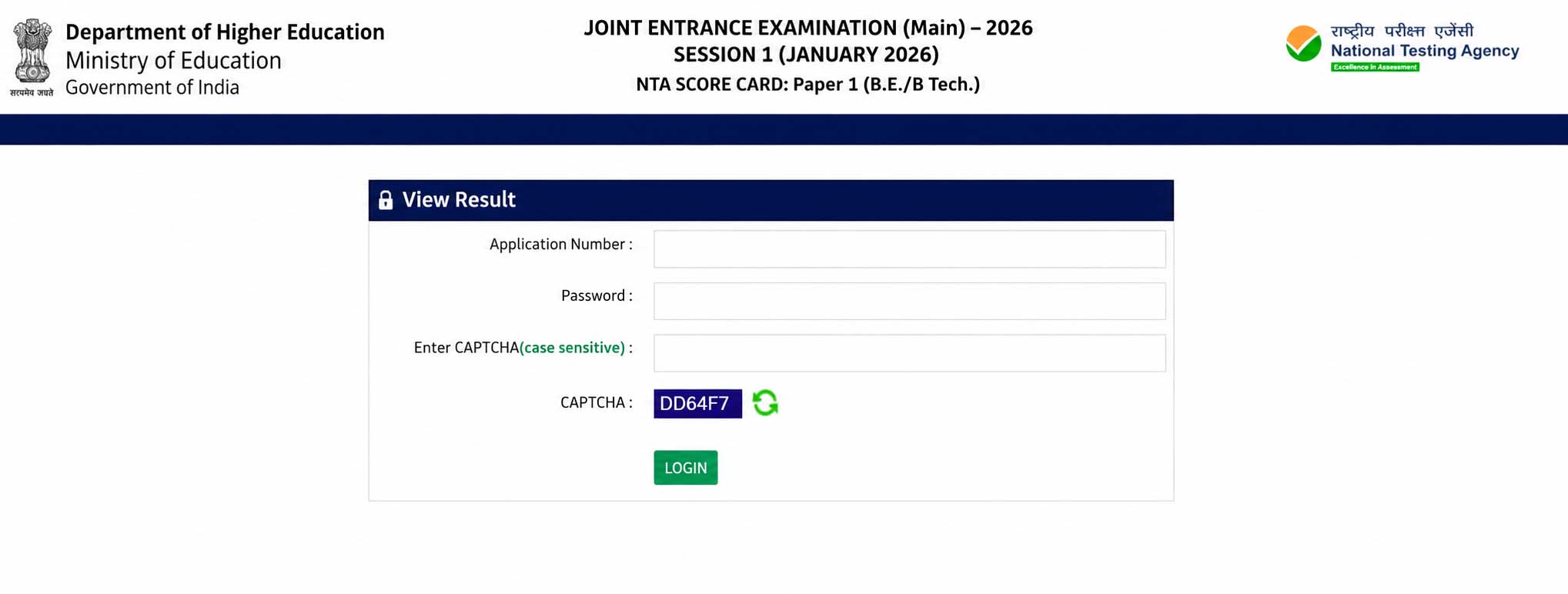
Navigate to jeemain.nta.nic.in.
-
Select the active JEE Main 2026 Result link on the homepage.
-
Log in using your Application Number and Password.
-
Click Submit to view your subject-wise NTA scores and percentile.
-
Save the scorecard PDF and print a physical copy.
-
Reminder: Download your scorecard before the July 31, 2026 portal archive deadline.
What’s on Your Final JEE Main 2026 Scorecard? Because JEE Main 2026 takes place across January and April, NTA compiles both attempts to issue a final consolidated rank sheet by April 20.
Key Information Included:
-
Total Scores: Individual marks and percentiles per session.
-
Best of Two Scores: The apex score considered for rank computation.
-
All India Ranks: CRL (Common Rank List) and Category Rank.
-
Reservation Category: Verified applicant category details.
-
JEE Advanced Cutoff: Category-wise benchmark to determine JEE Advanced registration clearance.
JEE Main 2026 BArch Result - (Paper 2)
The National Testing Agency (NTA) announced the online JEE Main Paper 2 (Session 2) results for BArch and BPlan courses at jeemain.nta.nic.in. The examination took place on April 7, 2026, following the Session 1 Paper 2 results that were declared earlier on February 24, 2026. Candidates accessed and downloaded their official scorecards from the portal using their JEE application number and password. Alongside the scorecards, the testing authority also published the official toppers list for both BArch and BPlanning candidates.
How to Check JEE Main Result 2026 Session 2 Online
The National Testing Agency (NTA) has officially released the JEE Main 2026 Session 2 results on its examination portal. The results for Paper 1 (B.E./B.Tech) were announced on April 20, 2026, followed by the Paper 2 (B.Arch/B.Plan) results on May 5, 2026. (Earlier, the Session 1 scorecards were declared on February 16, 2026).
To access your scorecard, you must log in using your registered credentials—Application Number and Password (or Date of Birth).
Details Printed on JEE Main 2026 Session 2 Scorecard: Complete Checklist
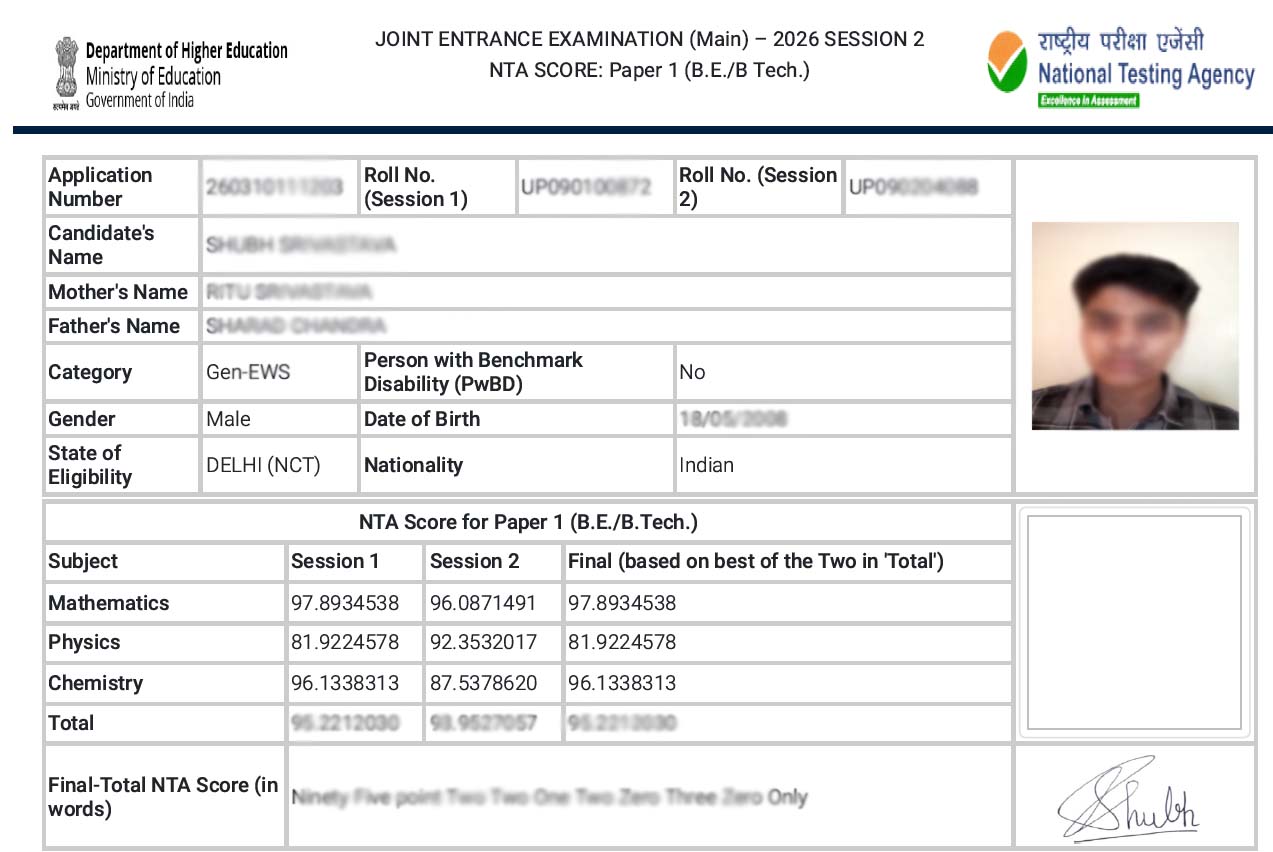
After downloading the NTA scorecard from the official website (jeemain.nta.nic.in), candidates must carefully verify every entry to ensure there are no discrepancies. The JEE Main 2026 Session 2 scorecard includes the following key details:
-
Personal Details: Candidate’s full name, roll number, application number, and parents’ names.
-
Demographic Information: Nationality and state code of eligibility (used to determine home-state quota seats in NITs).
-
Category & Reservation Status: Social reservation category (General, OBC-NCL, SC, ST, GEN-EWS) and PwD (Persons with Disability) status, if applicable.
-
Subject-Wise NTA Scores: Individual percentile scores obtained in Physics, Chemistry, and Mathematics.
-
Total NTA Score: Normalized overall aggregate percentile score.
-
Merit & Rank Data (Final Scorecard): All India Rank (AIR), Common Rank List (CRL) rank, category-wise rank, and the qualifying cutoff marks required for JEE Advanced eligibility.
JEE Main 2026 Expected Cutoff (Category-Wise)
The expected qualifying cutoff percentiles for JEE Advanced 2026 across different categories are detailed below. The official qualifying cutoff percentiles are announced alongside the JEE Main Session 2 final results.
| Category | Expected JEE Main 2026 Cutoff (Percentile) |
| General (UR) | 93 – 95 |
| OBC-NCL | 80 – 82 |
| EWS | 80 – 82 |
| SC | 60 – 62 |
| ST | 47 – 49 |
JEE Main Toppers 2026 - Session 2 Result
NTA announced the names of the 100 percentilers of the JEE Main 2026. The same will be updated below.Candidates can check the list of JEE Main Toppers from the following table
JEE Main 2026 Session 2 Toppers List (100 Percentile)
| Candidate Name | State of Eligibility | NTA Score (Percentile) |
| Aarush Singhal | Chandigarh | 100 |
| Jonnala Roshan Manideep Reddy | Andhra Pradesh | 100 |
| Shreyas Mishra | Delhi (NCT) | 100 |
| Mantha Shiva Kamesh | Telangana | 100 |
| Siddharth Shrikant Athaley | Maharashtra | 100 |
| Narendrababu Gari Mahith | Andhra Pradesh | 100 |
| Thunga Durga Suprabhath | Andhra Pradesh | 100 |
| Arnav Gandhi | Haryana | 100 |
| Shubham Kumar | Bihar | 100 |
| Aditya Gupta | Delhi (NCT) | 100 |
| Thammina Girish | Tamil Nadu | 100 |
| Kabeer Chhillar | Rajasthan | 100 |
| Chiranjib Kar | Rajasthan | 100 |
| Bhavesh Patra | Odisha | 100 |
| Anay Jain | Haryana | 100 |
| Atharva Panjabi | Delhi (NCT) | 100 |
| Arnav Gautam | Rajasthan | 100 |
| Doranala Bhavitesh Reddy | Telangana | 100 |
| Pasala Mohith | Andhra Pradesh | 100 |
| Madhav Viradiya | Maharashtra | 100 |
| Purohit Nimay | Gujarat | 100 |
| Sai Rithvik Reddy Venkatreddy Valla | Telangana | 100 |
| Vivan Sharad Mahiswari | Telangana | 100 |
| Bijjam Venkata Chandra Sekhar Reddy | Andhra Pradesh | 100 |
| Yashwardhan | Rajasthan | 100 |
| Rishi Premnath | Telangana | 100 |
JEE Main 2026 Session 1 Toppers List (100 Percentile)
| Application No. | Name of Candidate | State of Eligibility (Class 12th) | NTA Score |
| 260310038881 | Shreyas Mishra | Delhi (NCT) | 100 Percentile |
| 260310088709 | Narendrababu Garimahith | Andhra Pradesh | 100 Percentile |
| 260310164042 | Shubham Kumar | Bihar | 100 Percentile |
| 260310215465 | Kabeer Chillar | Rajasthan | 100 Percentile |
| 260310220953 | Chiranjib Kar | Rajasthan | 100 Percentile |
| 260310228381 | Bhavesh Patra | Odisha | 100 Percentile |
| 260310231839 | Anay Jain | Haryana | 100 Percentile |
| 260310241955 | Arnav Gautam | Rajasthan | 100 Percentile |
| 260310432915 | Pasala Mohith | Andhra Pradesh | 100 Percentile |
| 260310434363 | Madhav Viradiya | Maharashtra | 100 Percentile |
| 260310635369 | Purohith Nimay | Gujarat | 100 Percentile |
| 260310757063 | Vivan Sharad Maheswari | Telangana | 100 Percentile |
Previous Year JEE Main Toppers List (2025)
| Candidate Name | State |
| Md Anas | Rajasthan |
| Archisman Nandy | West Bengal |
| Devdutta Majhi | West Bengal |
| Aayush Ravi Chaudhari | Maharashtra |
| Lakshya Sharma | Rajasthan |
| Ayush Singhal | Rajasthan |
| Kushagra Gupta | Karnataka |
| Harssh A Gupta | Telangana |
| Aadit Prakash Bhagade | Gujarat |
| Daksh | Delhi |
| Harsh Jha | Delhi |
| Rajit Gupta | Rajasthan |
| Shreyas Lohiya | Uttar Pradesh |
| Saksham Jindal | Rajasthan |
| Saurav | Uttar Pradesh |
| Vangala Ajay Reddy | Telangana |
| Sanidhya Saraf | Maharashtra |
| Vishad Jain | Maharashtra |
| Arnav Singh | Rajasthan |
| Shiven Vikas Toshniwal | Gujarat |
| Kushagra Baingaha | Uttar Pradesh |
| Sai Manogna Guthikonda | Andhra Pradesh |
| Om Prakash Behera | Rajasthan |
| Bani Brata Majee | Telangana |
JEE Main 2026 Rank List
NTA issues both All India Ranks (AIR) and category ranks alongside the final JEE Main 2026 scorecard, calculated via normalized percentile scores.
Since participating institutes (NITs, IIITs, and GFTIs) allocate seats based strictly on rank rather than raw test scores, estimating your relative position is key to planning counselling choices. The trend-based marks vs rank comparison below provides a reliable projection of where your raw score out of 300 will land.
JEE Main 2026 Expected Marks vs Rank
| JEE Main Score (Out of 300) | Expected All India Rank (AIR) Range |
| 291 – 300 | 1 – 15 |
| 280 – 290 | 16 – 56 |
| 271 – 279 | 86 – 125 |
| 259 – 268 | 142 – 341 |
| 250 – 258 | 381 – 704 |
| 240 – 249 | 733 – 1,246 |
| 230 – 239 | 1,269 – 1,909 |
| 220 – 229 | 2,043 – 3,217 |
| 210 – 219 | 3,319 – 4,549 |
| 200 – 209 | 4,647 – 6,269 |
| 190 – 199 | 6,488 – 8,724 |
| 180 – 189 | 8,951 – 12,197 |
| 170 – 179 | 12,439 – 16,524 |
| 160 – 169 | 16,942 – 21,710 |
| 150 – 159 | 22,156 – 28,132 |
| 140 – 149 | 28,402 – 36,243 |
| 130 – 139 | 36,985 – 46,047 |
| 120 – 129 | 47,066 – 57,991 |
| 110 – 119 | 59,254 – 72,925 |
| 100 – 109 | 74,236 – 91,426 |
| 90 – 99 | 93,240 – 1,14,780 |
| 80 – 89 | 1,17,151 – 1,43,434 |
| 70 – 79 | 1,46,849 – 1,84,121 |
| 60 – 69 | 1,86,799 – 2,37,626 |
| 50 – 59 | 2,43,215 – 3,19,343 |
| 40 – 49 | 3,27,188 – 4,48,730 |
| 30 – 39 | 4,60,200 – 6,47,703 |
| 20 – 29 | 6,78,394 – 9,35,442 |
| 10 – 19 | 9,54,561 – 12,07,129 |
| 0 – 9 | 12,22,184 – 13,90,805 |
JEE Main 2026 Reservation
Admissions through JEE Main 2026 follow the reservation guidelines established by the Government of India. Centrally run institutions—including NITs, IIITs, and other central government-funded colleges—allocate a fixed percentage of seats to eligible candidates across designated categories. The breakdown below details the seat distribution policy applicable to all central institutes.
JEE Main 2026 Reservation Criteria for Central Government Institutes
| Category | Reservation Percentage |
|---|---|
| General - Economically Weaker Sections (GEN-EWS) | 10% |
| Scheduled Castes (SC) | 15% |
| Scheduled Tribes (ST) | 7.5% |
| Other Backward Classes - Non-Creamy Layer (OBC-NCL) | 27% |
| Persons with Disabilities (PwD) | 5% (Horizontal reservation across all categories) |
How Many Students Appeared for the JEE Main 2026 Exam?
Following the conclusion of the January session, the National Testing Agency (NTA) released official attendance and registration statistics for JEE Main 2026 Session 1. These figures offer key insights into overall exam attendance, verification rates, and the competition level among engineering aspirants.
JEE Main 2026 Session 1 Attendance Statistics (January Exam)
The table below outlines the shift-wise participation data across all exam dates (January 21, 22, 23, 24, and 28, 2026):
| Key Metrics / Exam Aspects | Session 1 Statistics (All Shifts) |
| Total Registered Candidates | 13,50,969 |
| Total Candidates Appeared | 13,00,368 |
| Overall Attendance Percentage | 96.26% |
| Identity-Verified Candidates (via Aadhaar) | 9,96,774 |
| Aadhaar Verification Rate | 96.19% |
| PwD Category Candidates Appeared | 4,314 |
Key Takeaways for Aspirants:
-
High Attendance Rate: Over 96.2% of registered aspirants appeared across the January shifts, marking one of the highest turnouts in recent years.
-
Massive Competition Base: With over 13 lakh candidates appearing in the first session alone, the percentile cutoffs for qualifying for JEE Advanced reflect strong competition across every score bracket.
JEE Main Result 2026: How Percentile is Calculated
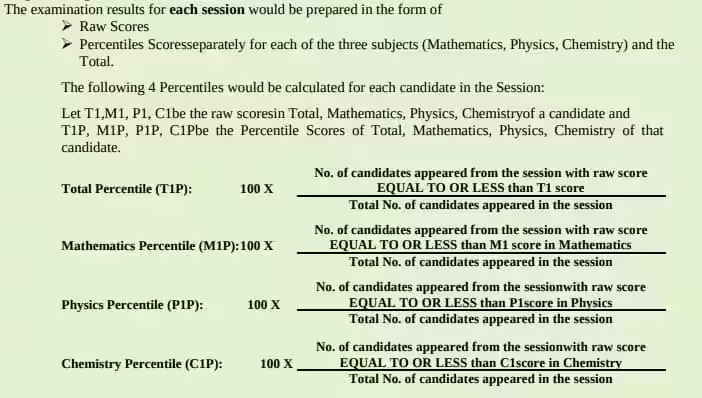
The National Testing Agency (NTA) computes JEE Main 2026 percentile scores individually for each subject (Physics, Chemistry, and Mathematics) as well as an aggregate score. To ensure fairness across shifts of varying difficulty levels, NTA applies a normalization formula based on the relative performance of all candidates within that specific session.
NTA Normalization Formula
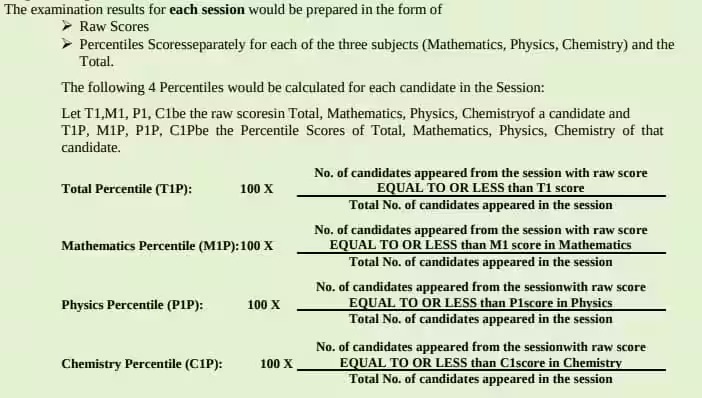
Percentile Score (T1P) = (100 X Number of candidates from the session with raw score equal to or less than T1 score)/Total number of candidates who appeared in the session
Formula Breakdown by Category
| Category | Percentile Code | Calculation Formula |
| Total Percentile | T1P | (100 X Number of candidates from the session with raw score equal to or less than T1 score)/Total number of candidates who appeared in the session |
| Mathematics Percentile | M1P | (100 X Number of candidates from the session with raw score equal to or less than M1 score in Mathematics)/Total number of candidates who appeared in the session |
| Chemistry Percentile | C1P | (100 X Number of candidates from the session with raw score equal to or less than C1 score in Chemistry)/Total number of candidates who appeared in the session |
| Physics Percentile | P1P | (100 X Number of candidates from the session with raw score equal to or less than P1 score in Physics)/Total number of candidates who appeared in the session |
How Does the NTA JEE Main Normalization Process Work?
To maintain parity and fairness across varying question paper sets, the National Testing Agency calculates percentile scores using a normalization methodology. This accounts for shift-to-shift variations in question difficulty and establishes an equitable baseline across all exam dates.
The normalized NTA score reflects where an examinee stands relative to all other test-takers within the same shift. It is derived using the standard normalization formula:
-
Calculation:
Percentile = (100 X number of candidates who appeared in the session with a raw score equal to or less than the candidate) / total number of candidates who appeared in that session
Percentile vs. Percentage: What Aspirants Must Know
The normalized NTA score is often confused with raw percentage. While raw percentage simply measures marks secured out of 300, the normalized percentile represents a candidate's comparative rank within their specific testing session.
JEE Main 2026: Inter-Se Merit & Tie-Breaking Criteria
When two or more candidates obtain identical total NTA scores in JEE Main 2026, the National Testing Agency (NTA) applies a standardized Inter-Se Merit / Tie-Breaking Rule to assign unique All India Ranks (AIR). The criteria are evaluated sequentially in descending order of priority until the tie is resolved.
Tie-Breaking Methodology: Paper 1 (B.E. / B.Tech)
If two or more candidates secure the same aggregate NTA score in Paper 1, the following hierarchy is used to determine rank:
-
Higher NTA Score in Mathematics: The candidate with a higher percentile in Mathematics gets preference.
-
Higher NTA Score in Physics: If the tie persists, the candidate with a higher percentile in Physics is ranked higher.
-
Higher NTA Score in Chemistry: If the tie remains unresolved, the higher percentile in Chemistry is considered.
-
Lower Negative-to-Positive Response Ratio (Mathematics): Preference is given to the candidate with fewer incorrect responses relative to correct responses in Mathematics.
-
Lower Negative-to-Positive Response Ratio (Physics): The candidate with fewer incorrect responses relative to correct responses in Physics receives preference.
-
Lower Negative-to-Positive Response Ratio (Chemistry): Preference goes to the candidate with fewer incorrect responses relative to correct responses in Chemistry.
Tie-Breaking Methodology: Paper 2A (B.Arch)
For candidates scoring equal aggregate marks/percentile in Paper 2A, the following sequential criteria are applied:
-
Higher NTA Score in Mathematics
-
Higher NTA Score in Aptitude Test
-
Higher NTA Score in Drawing Test
-
Lower Negative-to-Positive Response Ratio: The candidate with a lower proportion of attempted negative responses across the entire test paper is ranked higher.
-
Age Criterion: If all academic metrics are identical, the older candidate is awarded the higher rank.
JEE Main 2026 Session 1 Result Highlights
The key administrative details and release dates for the JEE Main 2026 Session 1 results are summarized below:
| Parameter | Details |
| Exam Conducting Body | National Testing Agency (NTA) |
| Official Result Portals |
• • |
| Session 1 Paper 1 Result Date | February 16, 2026 (Declared) |
| Session 1 Paper 1 Result Time | 6:20 PM |
| Session 1 Paper 2 Result Date | February 24, 2026 (Declared) |
| Declaration Mode | Online (Computer-Based Scorecard) |
JEE Main 2026 Expected Marks vs Percentile
| Marks Range (Out of 300) | Expected Percentile Range |
| 291 – 300 | 100 – 99.999 |
| 280 – 290 | 99.99890732 – 99.99617561 |
| 271 – 279 | 99.99417236 – 99.99153171 |
| 259 – 268 | 99.99034797 – 99.97687156 |
| 250 – 258 | 99.97413985 – 99.95228621 |
| 240 – 249 | 99.95028296 – 99.91549924 |
| 230 – 239 | 99.91395128 – 99.87060821 |
| 220 – 229 | 99.86150253 – 99.78191884 |
| 210 – 219 | 99.77499852 – 99.69159044 |
| 200 – 209 | 99.68494329 – 99.57503767 |
| 190 – 199 | 99.56019541 – 99.40858575 |
| 180 – 189 | 99.39319714 – 99.17311273 |
| 170 – 179 | 99.15672250 – 98.87981861 |
| 160 – 169 | 98.85149993 – 98.52824811 |
| 150 – 159 | 98.49801724 – 98.09290531 |
| 140 – 149 | 98.07460288 – 97.54301298 |
| 130 – 139 | 97.49274960 – 96.87838902 |
| 120 – 129 | 96.80927687 – 96.06871150 |
| 110 – 119 | 95.98302700 – 95.05625037 |
| 100 – 109 | 94.96737888 – 93.80203330 |
| 90 – 99 | 93.67910655 – 92.21882783 |
| 80 – 89 | 92.05811248 – 90.27631202 |
| 70 – 79 | 90.04484550 – 87.51810893 |
| 60 – 69 | 87.33654157 – 83.89085926 |
| 50 – 59 | 83.51197170 – 78.35114254 |
| 40 – 49 | 77.81927947 – 69.57972710 |
| 30 – 39 | 68.80219265 – 56.09102043 |
| 20 – 29 | 54.01037138 – 36.58463962 |
| 10 – 19 | 35.28853640 – 18.16647924 |
| 0 – 9 | 17.14582299 – 5.71472799 |
JEE Main 2026: Re-Evaluation and Re-Checking Policy
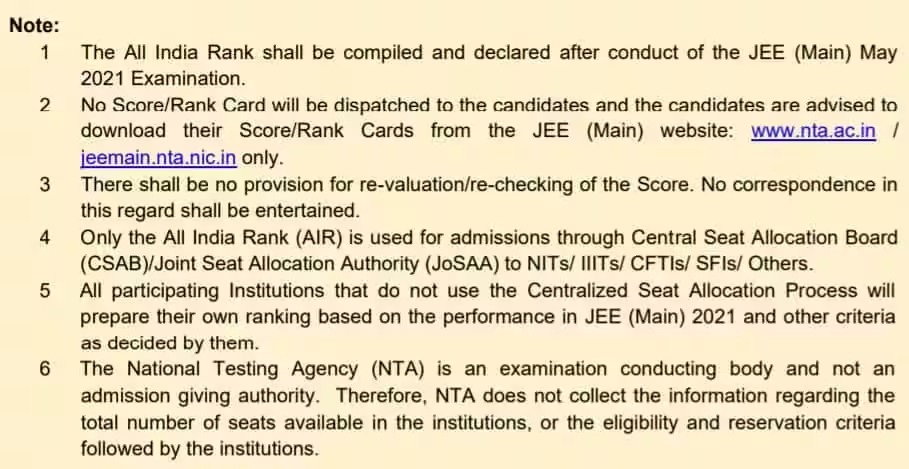
The National Testing Agency (NTA) follows a strict policy regarding the evaluation of answer sheets. There is no provision for re-evaluation, re-checking, or re-totalling of JEE Main 2026 scores.
Because the examination is conducted as a Computer-Based Test (CBT) and evaluations are processed digitally using verified final answer keys, the NTA percentile scores declared on the official portal are treated as final and non-negotiable. NTA will not entertain any correspondence, representations, or appeals in this regard.
Difference Between JEE Main Percentage and Percentile Score
A common point of confusion among aspirants is treating percentage and percentile as interchangeable metrics. However, they evaluate exam performance on fundamentally distinct parameters:
-
Percentage (Absolute Performance): Indicates the actual marks a candidate scores out of the total achievable marks (300).
-
Percentile (Relative Performance): Reflects the proportion of candidates in a particular exam shift who scored equal to or lower than that candidate.
Formula Comparison
{JEE Main Percentage} = (100 x Marks obtained by candidate) / Total marks
{JEE Main Percentile Score 2026} = (100 x Number of candidates in the session with aggregate marks less than that obtained by the candidate / Total number of candidates who appeared in that session
Example: A 99 percentile does not mean an aspirant scored 99% of the marks. It signifies that the aspirant scored higher than or equal to 99% of the test-takers in that specific shift.
Can You Check the JEE Main 2026 Result by Name?
No. NTA does not offer a search-by-name feature to check JEE Main results.
To safeguard candidate privacy and prevent unauthorized access to scorecards, access is strictly restricted through authenticated login credentials:
-
Application Number
-
Password (or Date of Birth)
Aspirants who misplace their application number can recover it using the "Forgot Application Number" utility on the official NTA login page (jeemain.nta.nic.in) by providing their registered email address and mobile number.
JEE Main & JoSAA Seat Matrix (Reference Data)
The official seat matrix for admissions through JEE Main and JEE Advanced is finalized ahead of the Joint Seat Allocation Authority (JoSAA) counselling rounds. Based on established seat allocation trends across 126 premier institutes (including 32 NITs, 26 IIITs, and 45 GFTIs), the broad seat breakdown is summarized below:
| Institute Type | Total Available Seats (Includes Female Supernumerary) |
| Indian Institutes of Technology (IITs) (via JEE Advanced) | 18,160 |
| National Institutes of Technology (NITs) | 24,525 |
| Indian Institutes of Information Technology (IIITs) | 9,940 |
| Government Funded Technical Institutes (GFTIs) | 10,228 |
| Total Seats Available | 62,853 |
Top 10 Engineering Colleges in India (NIRF Rankings)
While the Ministry of Education updates annual institutional rankings under the National Institutional Ranking Framework (NIRF), the leading engineering institutions in India provide benchmark cutoffs for top scorers:
| NIRF Rank | Engineering Institute |
| 1 | Indian Institute of Technology Madras (IIT Madras) |
| 2 | Indian Institute of Technology Delhi (IIT Delhi) |
| 3 | Indian Institute of Technology Bombay (IIT Bombay) |
| 4 | Indian Institute of Technology Kanpur (IIT Kanpur) |
| 5 | Indian Institute of Technology Kharagpur (IIT Kharagpur) |
| 6 | Indian Institute of Technology Roorkee (IIT Roorkee) |
| 7 | Indian Institute of Technology Hyderabad (IIT Hyderabad) |
| 8 | Indian Institute of Technology Guwahati (IIT Guwahati) |
| 9 | National Institute of Technology Tiruchirappalli (NIT Trichy) |
| 10 | Indian Institute of Technology (BHU) Varanas |
Frequently Asked Questions (FAQs)
You can check and download your scorecard directly from the official NTA examination portals at jeemain.nta.nic.in or nta.ac.in.
You need your registered Application Number and Password (or Date of Birth).
No. NTA does not provide an option to search or access results using a candidate's name or roll number. Access is strictly password-protected via your application number.
If you appeared in both January and April sessions, NTA considers the higher (best) of the two total percentile scores to determine your final All India Rank (AIR) and category rank.
Percentage reflects your absolute marks scored out of 300, whereas percentile is a relative performance metric indicating the percentage of candidates in your exam shift who scored equal to or less than you.
No. NTA strictly prohibits re-evaluation, re-checking, or re-totalling of scores. The scorecards generated based on the final answer key are conclusive.
For Paper 1, ties are broken sequentially: higher percentile in Mathematics, followed by Physics, then Chemistry, and finally lower negative-to-positive response ratios in each subject.
The category-wise cutoff percentile determines whether you are eligible to register for JEE Advanced 2026 to compete for seats across the Indian Institutes of Technology (IITs).
JEE Main ranks are used for seat allocation across 32 NITs, 26 IIITs, 40+ GFTIs, and various state government or private engineering institutions through JoSAA and CSAB counselling.
A score of 75 marks out of 300 is an average-to-moderate score, translating roughly to an 88.5 to 90.5 percentile (AIR ~1.45–1.85 lakh). It is generally below the JEE Advanced cutoff for General candidates, but it is sufficient to qualify for reserved categories (OBC-NCL, EWS, SC, ST) and secure admission into select state government colleges, newer NIT branches, or private engineering institutions.
A 53 percentile generally corresponds to 27 to 33 raw marks out of 300, depending on shift difficulty. This places a candidate’s All India Rank around 6.5 to 7.2 lakh, which is insufficient for NIT/IIIT admissions or qualifying for JEE Advanced across most categories.